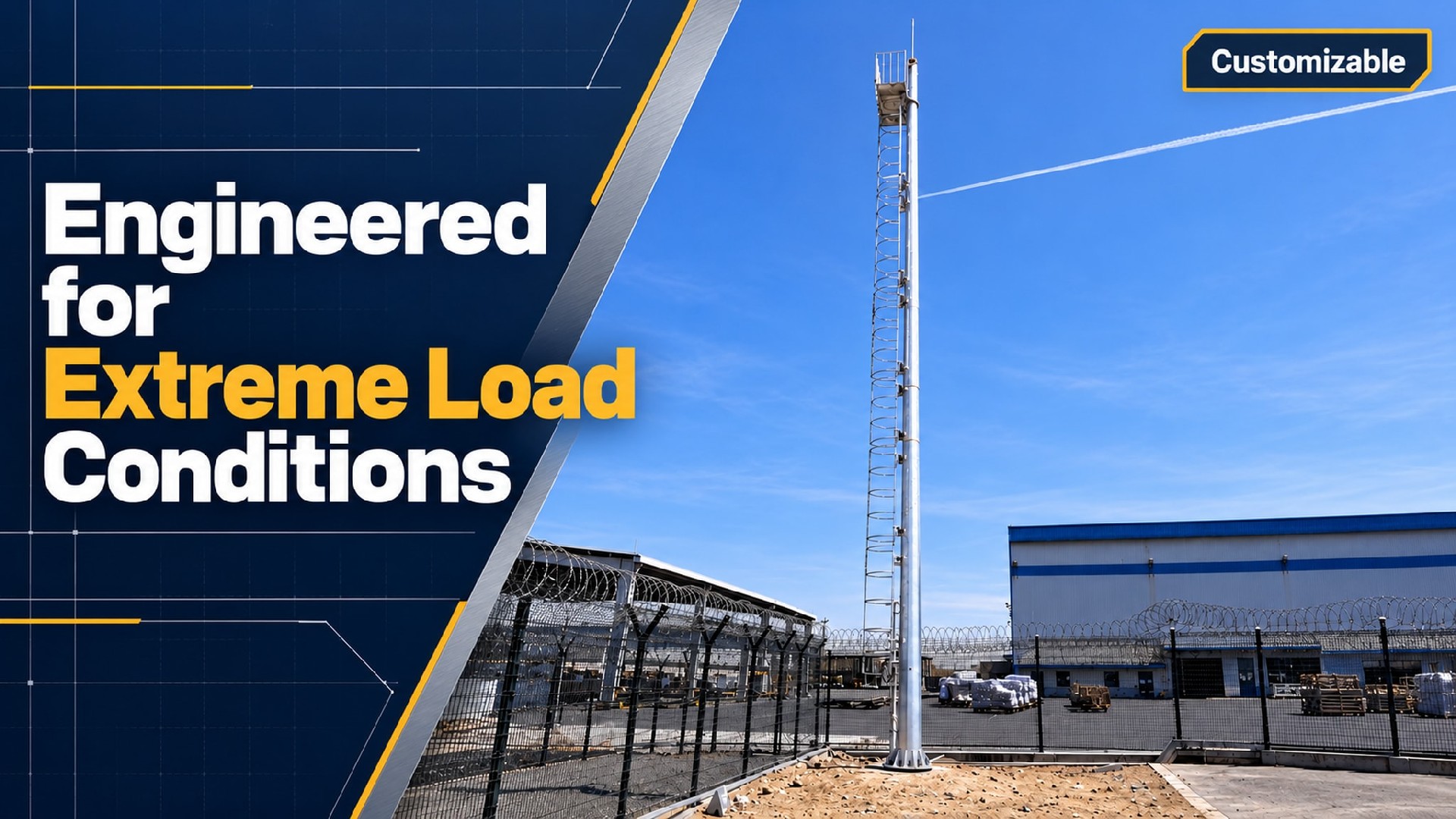
Core Value Proposition
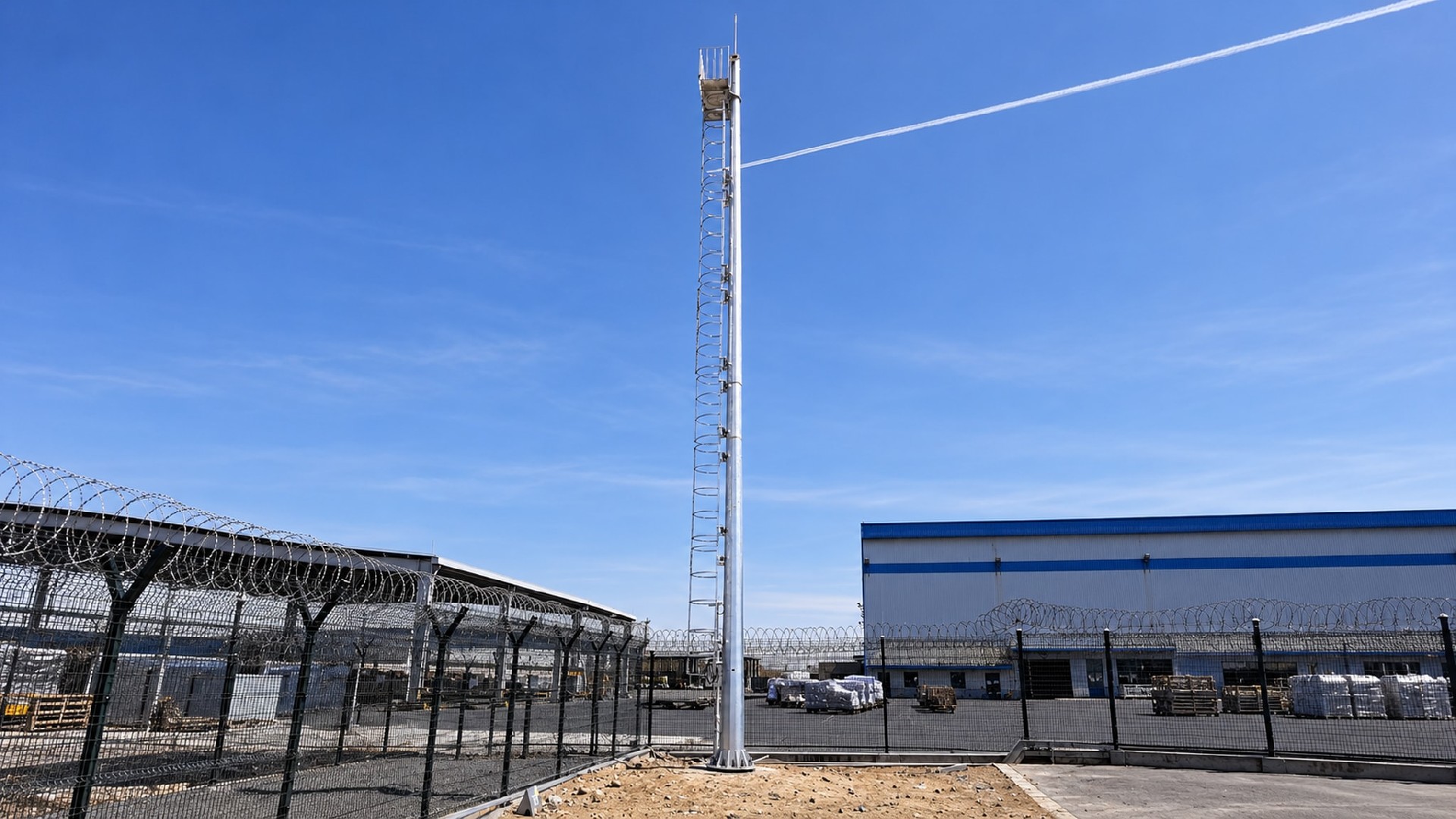
Built to deliver absolute engineering certainty in the world’s most demanding operating conditions. Designed to securely support heavy-duty AI edge servers, PTZ surveillance arrays, and high-precision radar equipment, our poles maintain exceptional flexural rigidity and structural stability under extreme wind loads up to 120 km/h. Protected by a dual-layer defense system combining hot-dip galvanizing and electrostatic powder coating, these poles deliver superior corrosion resistance in harsh outdoor environments. The zinc layer provides active cathodic protection, while the powder coating acts as a robust physical barrier against moisture and pollutants, ensuring the long-term, fail-safe operation of critical municipal and intelligent transportation assets.
| Design Criteria | |
| Basic Wind Speed | 49 m/s (3-sec gust, ≈177 km/h) @10 m height, Exposure Category C |
| Wind Load Standard | ASCE 7-16 |
| Seismic Design | PGA 0.05 g–0.20 g |
| Seismic Standard | ASCE 7-16 |
| Product Specifications | |
| Height Range | 8 m – 20 m |
| Material Options | Q235B (Eqv. ASTM A36 / EN S235JR) Q355B (Eqv. ASTM A572 Gr.50 / EN S355JR) |
| Corrosion Protection | |
| Hot-Dip Galvanizing(HDG) | ≥ 85 μm |
| Powder Coating | ≥ 80 μm |
Our poles meet strict international quality and safety standards.
This supports smooth customs clearance and local project approval in your region.
Key Advantages
High-Strength Structural Steel: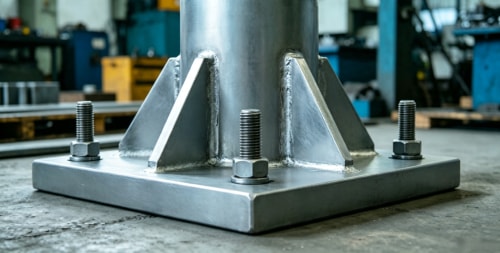
High-Strength Steel: Q355B (Eqv. ASTM A572 Gr.50/EN S355JR).
Yield Strength: > 355 MPa.
Superior Rigidity:
Stable Mounting for AI Servers & Radar Systems.
Calculated service‑level deflection ≤ H/200 under design wind‑load conditions
Vibration-Free Performance.
Precision Fabrication
Flange Thickness: 20 - 40 mm.
Flange flatness ≤ 1.5 mm.
Perpendicularity ≤ 0.5°.
Shaft straightness tolerance ≤ H/750.
Rigorous Quality Control
Critical structural welds feature a minimum penetration depth of 2 mm.
100% Ultrasonic Testing (UT) for defect-free reliability.
HDG: Zinc coating thickness ≥ 85 μm (fully compliant with ISO 1461:2022).
Salt Spray Test (ASTM B117): ≥ 1,000 h NSS.
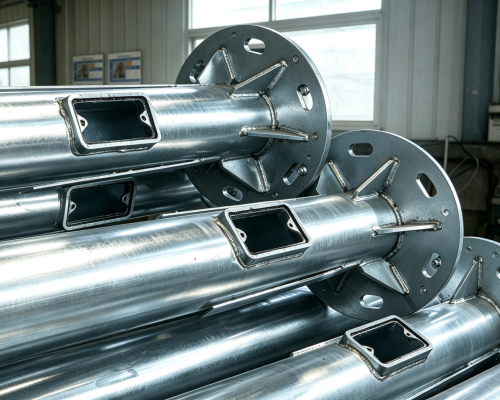
Cameras: Bullet, PTZ, Dome (Standard Interface), Laser PTZ.
Sensors: Environmental, Traffic & Methane Gas Detection.
Enclosures: Universal Security Power Supplies & Battery Enclosures.
Factory Pre-drilled: Routing holes, mounting brackets & enclosure cutouts.
Fasteners Included: 304 SS screws & high-strength carbon bolts.
Zero On-site Fabrication: Saves installation time & labor costs.
Brand Compatibility: Hikvision, Dahua, Uniview, Axis, Bosch, etc.
Customization: Tailored hole drilling based on CAD drawings or physical samples for an exact fit.
⚠ Critical Selection Reminder:
If your project is located on highways, intersections, or coastal wind zones, and requires mounting heavy-duty equipment such as PTZ cameras or radars, you must select heavy-duty compliant poles with:
• Flange Flatness ≤ 1.5 mm
• Weld Penetration Depth ≥ 2 mm
• Hot-Dip Galvanizing(HDG) Thickness ≥ 85 μm
Standard poles (Flange Flatness ≤ 3 mm, Penetration ≥ 1.5 mm, Galvanizing ≥ 65 μm) cannot meet the acceptance requirements for such scenarios or guarantee a 20-year design life. Using them poses a severe toppling risk and leads to exorbitant long-term maintenance costs.
We provide custom wind-load calculation reports, 2D CAD drawings, installation manuals, and tender technical documents to support your global project approvals and customs clearance.
For general-purpose technical handbooks and safety guidelines, please visit our Download Center→
Complete MTCs and size inspection reports for every batch.
Support third-party inspections (SGS/TÜV/Intertek) upon request.
Custom manuals & data sheets aligned with local standards (EN/ASTM/AASHTO).
Multi-language versions supported.
Available in both Digital & hard copy for on-site use.
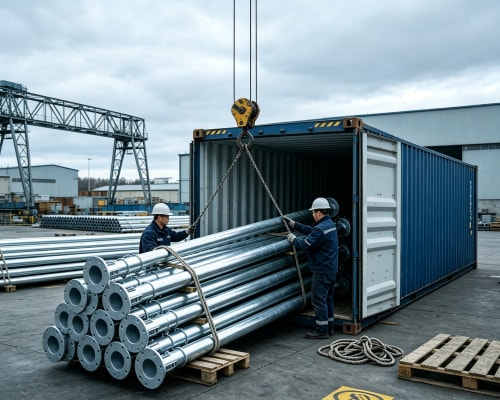
Save up to 15% on freight with optimized lashing and packing.
Export-grade, moisture-proof & shock-resistant packaging for safe ocean transit.
95% On-Time Delivery Rate with real-time production tracking.
A dedicated Project Manager provides weekly progress updates until shipment.
• Fastener Compatibility: Fasteners must match the pole material. Direct contact between dissimilar metals is strictly prohibited to prevent galvanic corrosion.
• Drainage & Sealing: Keep the base drainage holes clear and ensure the access door is tightly sealed. The flange must never be buried in the soil.
• Coating Integrity: The powder coating must be free of impact damage. Any damaged areas must be promptly repaired using the provided touch-up paint.
• Grounding System: Ensure correct connection and equipotential bonding. The measured grounding resistance must comply with local electrical codes.
• Foundation Requirements: The foundation and anchor bolts must meet local wind-load ratings. The pole should be erected only after the concrete has fully cured.
1. Can your steel surveillance poles accommodate our cameras and other equipment?
Yes. Mounting brackets and interfaces can be designed to suit your equipment. Please provide equipment models or mounting drawings, quantities, weights, dimensions and mounting positions.
Include any lighting, communications or other devices in the equipment list so we can assess the combined loads, wind area and mounting space.
2. How are pole height, diameter and wall thickness determined? Is equipment weight enough for selection?
Equipment weight is only one design input. Pole height, equipment wind area, outreach length, mounting positions and site wind conditions also affect the required configuration.
Equipment with the same weight may require different pole designs depending on its wind area and position. Send your existing drawings for review, or share your equipment and site details for preliminary selection.
3. How do you address image stability for long-range or PTZ cameras?
Alongside structural capacity, these installations may require assessment of pole-top displacement, rotation and dynamic response under wind loading.
Please provide any stability criteria specified by the camera supplier or project consultant. We can assess these requirements within the agreed design scope and confirm the relevant load conditions and limits.
4. Are galvanized steel surveillance poles suitable for coastal or industrial sites?
They can be considered following a review of the site environment. Salt deposition, humidity, industrial pollutants and maintenance access help determine whether hot-dip galvanizing alone or an additional coating system is appropriate.
For more aggressive environments or sites with restricted maintenance access, stainless steel and other options can also be evaluated against initial and maintenance costs.
5. What galvanizing thickness do you provide? Can it be inspected to ISO 1461?
Hot-dip galvanizing can be specified and inspected to ISO 1461 or other agreed project requirements. Applicable coating thickness and acceptance criteria depend on steel thickness, component type and the specified standard.
Please state any required coating thickness, measurement method or inspection documentation at the quotation stage so these can be reviewed and included in the agreed technical requirements.
6. Can the pole allow for additional equipment in the future?
Yes. Future equipment can be considered during design, with suitable mounting interfaces and capacity allowances. Please provide the anticipated equipment weight, wind area and mounting positions.
Any later additions should be checked against the original design conditions, particularly where they involve new outreach arms, larger wind areas or changes in mounting height.
Specifications are typical values for reference only under standard conditions — not a guarantee. Final performance shall be determined by project design calculations and factory test reports. Consult a local engineer before specifying.